APOD
The Astronomy Picture of the Day is a wonderful web site that puts up a different astronomy-related picture every day. However, the site does not have an RSS feed. This page fixes that deficiency.
Updated: 3 hours 14 min ago
Lunar Corona over Cochem Castle
This
bat-like apparition does not shine on clouds passing
over Gotham city.
Instead, the cloud bank in silhouette against a colorful
lunar corona
was spotted on the
evening of May 18
over Cochem, Germany from the banks of the river Mossele.
The lunar corona is formed as bright moonlight is diffracted
by water droplets in thin clouds drifting in front of the lunar disk.
Below it lies the region's historic
Cochem Castle
dating from the 11th century, and not
Wayne Manor.
Still, regardless of your location on planet Earth it is
well worth scanning the evening skies this weekend, as a Full Moon rises and
bright planets gather in the west.
Caterpillar Moon
Caterpillar Moon
A close series of consecutive exposures are combined in this intriguing
composite of the Full Moon slowly crawling,
across the sky.
Beginning on the upper right at 19:42 UT and ending at 22:14 UT on
April 25,
the sequence follows the Moon from Germany as it passes
through Earth's shadow in a partial lunar eclipse.
Near the top, the Moon just grazes the southern edge of
Earth's dark central shadow, or umbra.
But the
decreased brightness
in the darker part of the outer shadow region, the penumbra,
is also apparent on the lunar disk.
In fact,
the relative size and shape of the Earth's
shadow regions
and the Moon are easier to see along the segments of
this lunar caterpillar.
Nearly impossible to follow with the eye though, a penumbral lunar eclipse,
the Full Moon passing only through the pale outer penumbral shadow,
will
begin on May 25.
Messier 109
Messier 109
Beautiful barred spiral
galaxy M109,
109th entry in Charles Messier's famous catalog of bright
Nebulae
and Star Clusters, is
found
just below the Big Dipper's bowl in the
northern constellation Ursa Major.
In telescopic views, its striking central bar gives the galaxy the
appearance of the Greek letter "theta", θ, a common mathematical
symbol representing an angle.
Of course M109 spans a very small
angle in planet
Earth's sky, about 7 arcminutes or 0.12 degrees.
But that small
angle
corresponds to an enormous 120,000 light-year diameter
at the galaxy's estimated 60 million light-year distance.
The brightest member of the now
recognized
Ursa Major galaxy
cluster, M109 (aka NGC 3992) is joined by
three spiky
foreground stars strung out
across this frame.
The three small, fuzzy bluish galaxies also on the scene, identified
left to right as UGC 6969, UGC 6940 and UGC 6923,
are possibly satellite galaxies of the larger M109.
Comet PanSTARRS Anti-Tail
Once the famous
sunset comet,
PanSTARRS (C/2011 L4)
is now visible all night from much of the northern hemisphere,
bound for the outer solar system as it
climbs high above
the ecliptic plane.
Dimmer and fading, the comet's
broad dust tail
is still growing, though.
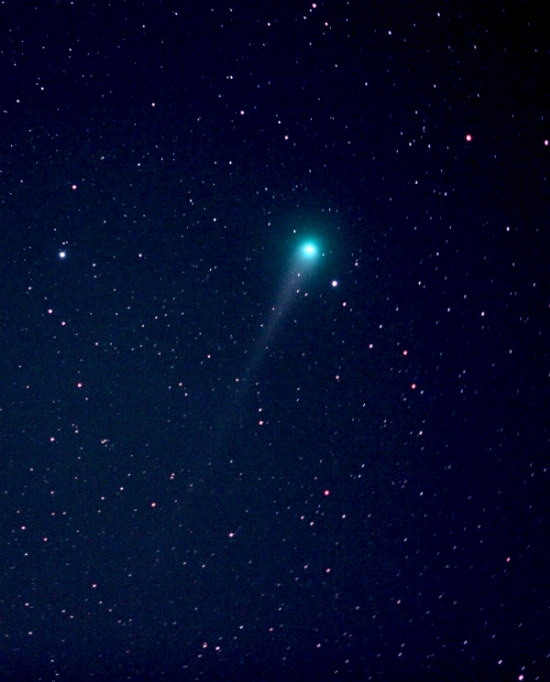
This widefield telescopic image
was taken against the starry
background of the constellation Cepheus on May 15.
It shows the
comet has developed an extensive
anti-tail,
dust trailing along the comet's orbit (to the left of the coma),
stretching more than 3 degrees across the frame.
Since the comet is just over 1.6
astronomical units from planet Earth,
that corresponds to a distance of over 12 million kilometers.
In late May Comet PanSTARRS
will pass within a few degrees of the north celestial pole.
The Waterfall and the World at Night
Above this boreal
landscape, the arc of the Milky Way and
shimmering aurorae flow through the night.
Like an echo, below them lies Iceland's spectacular
Godafoss,
the Waterfall of the Gods.
Shining just below the Milky Way, bright Jupiter is
included
in the panoramic nightscape recorded on March 9.
Faint and diffuse, the Andromeda Galaxy (M31) appears immersed
in the auroral glow.
The digital stitch of four frames is a first place winner in the
2013
International Earth and Sky Photo Contest
on Dark Skies Importance organized by
The World at Night.
An evocative record of the beauty of planet Earth's night sky,
all the contest's
winning entries are
featured in this video.
Four X-class Flares
Four X-class Flares
Swinging around the Sun's eastern limb on Monday,
a group of sunspots labeled active region AR1748 has produced the
first four X-class solar flares of 2013
in less than 48 hours.
In time sequence clockwise from the top left,
flashes from the four were captured in extreme ultraviolet images
from the Solar Dynamics Observatory.
Ranked
according
to their peak brightness in X-rays, X-class flares
are the most powerful class and are frequently accompanied by
coronal
mass ejections (CMEs),
massive clouds of high energy plasma launched into space.
But CMEs from the first three flares were not Earth-directed,
while one associated with the fourth flare may deliver a
glancing blow to the
Earth's magnetic field
on May 18.
Also causing temporary radio blackouts, AR1748 is likely not finished.
Still forecast
to have a
significant chance
of producing
strong flares, the active region is rotating
into more direct view
across the Sun's nearside.
Cape York Annular Eclipse
This week the shadow of the New Moon
fell on planet Earth, crossing
Queensland's Cape York
in northern Australia ...
for the second time in six months.
On the morning of May 10, the
Moon's apparent size was
too small to completely cover the Sun though, revealing a
"ring of fire"
along the central path of the annular
solar eclipse.
Near mid-eclipse from Coen, Australia, a
webcast
team captured this telescopic snapshot of the annular phase.
Taken with a
hydrogen-alpha filter, the dramatic image
finds the Moon's silhouette just within the solar disk,
and the limb of the active Sun spiked with solar prominences.
Still, after hosting back-to-back solar eclipses, northern Australia
will miss the next and
final
solar eclipse of 2013.
This November, a rare hybrid eclipse
will track across the North Atlantic and equatorial Africa.
Messier 77
Messier 77
Face-on
spiral galaxy M77
lies a mere 47 million light-years away
toward the aquatic
constellation Cetus.
At that estimated distance,
the gorgeous
island universe is
about 100 thousand light-years across.
Also known as NGC 1068, its compact and very bright core
is well studied
by astronomers exploring the
mysteries of supermassive black holes
in active Seyfert
galaxies.
M77 is also
seen at x-ray, ultraviolet, infrared, and radio wavelengths.
But this sharp visible
light image based on Hubble data follows its winding
spiral arms traced by obscuring dust clouds and
red-tinted star forming regions close in to the galaxy's luminous core.
Ring of Fire over Monument Valley
As the New Moon
continues this season's celestial shadow play,
an annular
solar eclipse track begins in western Australia
at 22:30 UT on May 9 --
near
sunrise on May 10 local time.
Because the eclipse occurs within a few days
of lunar apogee,
the Moon's silhouette does not quite cover the Sun
during mid-eclipse, momentarily creating a
spectacular ring of fire.
While a larger region witnesses a partial eclipse,
the annular mid-eclipse phase is visible along a shadow track
only about 200 kilometers wide but 13,000 kilometers long,
extending across the central Pacific.
For given locations along it,
the ring of fire lasts from 4 to 6 minutes.
Near the horizon, the appearance of the May 9/10
annular eclipse (online viewing)
is suggested by this dramatic composite from May of 2012.
The timelapse sequence depicts an annular eclipse in progress before sunset
over Monument Valley in the
southwestern United States.