S*T*A*R Back
Back
S*T*A*R Events
S*T*A*R
Events
Observing
Observing
Astro Photos
Astro
Photos
Telescope Making
Telescope
Making
LightPollution
Light
Pollution
Library
Library
Spectrogram
Spectrogram
Newsletter
Members
Members
Discussion Board
Discussion
Board
Club
Club
Links
Links

Mid-Atlantic Mirror Grinding Seminar

Mallard Lodge March 2-4, 2001 I went to the first annual Mid-Atlantic Mirror Grinding Seminar hosted by the Delmarva Stargazers. Although familial responsibilities and impending weather conditions caused me to miss part of it, I had a great time.

The seminar was held at the Mallard lodge in Delaware. The lodge is a nature center, situated on lovely grounds and inhabited by tanks of fish, turtles, and (this weekend) ATMs.

Folks Grinding There were 17 mirror grinding stations set up, where 17 ATMs were busy grinding 6" and 8" mirrors (mostly 8"). Those who brought their own mirrors (like me) had to fend for themselves for table space for grinding/polishing/figuring. Not a problem, because everyone was so darn nice! I was refiguring a 13" Coulter mirror, so I was mostly an observer. The room adjacent to the grinding room was the dining room for meals, but was otherwise taken over by Don Surles and other members of the Delmarva Stargazers poured laps. I learned a lot about melting, pouring, and channelling pitch laps, and even got to mind the pitch pots for a while.

pouring the pitch lap Here we see Don pouring a pitch lap on a plate glass tool. The tool is first wrapped with masking tape to form a dam. The pitch (Gugolz 64) is melted on an electric hot plate until its like thin molasses, and poured to a depth of about 1/4". The mirror and channeling mat are coated liberally with barnesite. Barnesite is a polishing compound that is no longer sold. It was used because it happened to be layong around. Cerium oxide polishing compound or rouge is just as good. The polishing compound is mixed with water and dish soap into a rather thick mixture.

removing the tape When the pitch seems cool enough to hold its shape annd not run over the sides, Don removes the tape and presses any stray pitch back into place with his fingers. Don has asbestos fingers (sort of, at that point the pitch isn't really that hot).

forming the channels The channeling mat (which is basically a rubbery material with squares cut out) is placed on top of the lap. The mat is placed so that the center of the lap doesn't correspond to either the center of edge of a square. The offset is different in each direction as well, so that there is no "regularity" in any direction across the lap. Then, the mirror is placed, concave side down, on top and pressed hard, so that the mat sinks into the pitch and the pitch forms squares that come into contact with the mirror. The mirror is lifted off, and a piece of nylon fishnet (like the stuff fruit bags are usually made of) is placed on top, and the mirror pushed down again. This makes "microfacets", which give the lap a bit more texture.

trimming the lap The lap is placed in water until it has cooled to room temperature. Newspapers are spread on the floor, and Don quickly runs a utility knife around the edge of the lap, to chip off any pitch protruding over the edge. The pitch is brittle at this point. The red color on the lap in the photo is barnesite left over from the pressing.

the finished lap Here we see the finished lap (actually, the one we saw being made was an 8" lap, and this is a 6" lap). The white on it is cerium oxide polishing compound. The red is some stubborn barnesite still stuck in some of the channels.

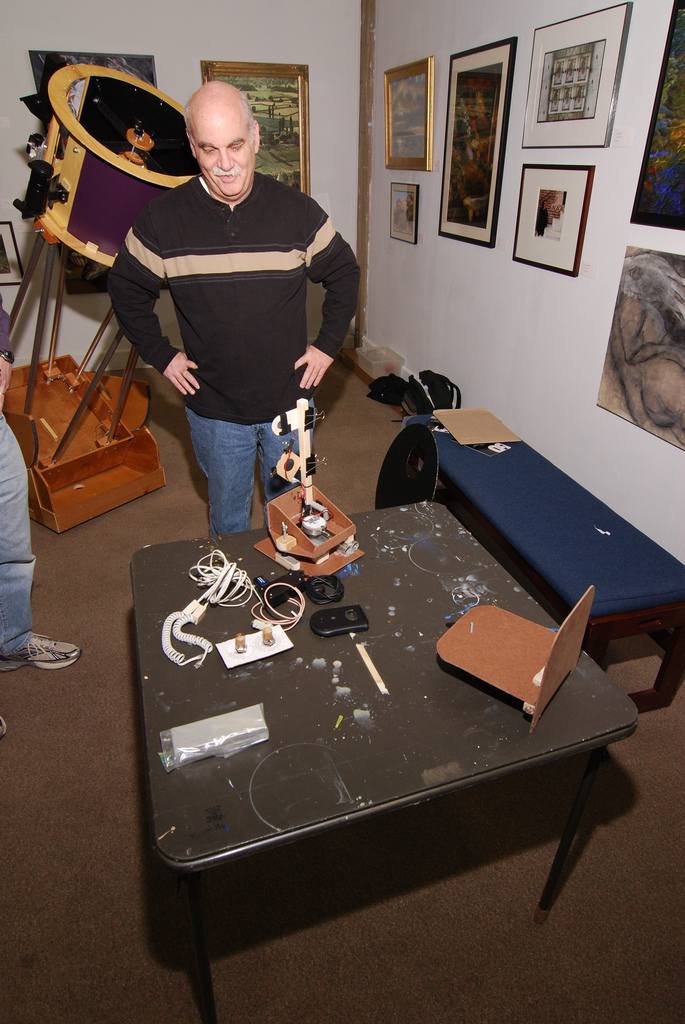
ronchi testing a mirror There were several testing stations set up, where people could bring their mirrors for testing. Steve Swayze, of Swayze Optical, was manning his own tester downstairs, next to the lap pouring station.

tester It consists of a plywood base and column, to which is attached an aluminum bar that can slide up or down. In the roght hand side of the bar are two holes; one to look through and one which holds a red LED diffused by ground glass and powered by the battery and potentiometer seen at the bottom right of the tester. The bar also had a quarter round piece with a handle (shown here with the handle sticking up), which held a ronchi screen and a knife edge for foucault testing.

The tester was very easy to set up and use, thanks to the heght adjustment, and Steve spent many hours sitting behind it. He also brought a lens, in a plywood cell on a stand just like the tester shown here. Unfortunately, the photo I took of it didn't turn out. The lens is a precision one used for the ross null test, which STeve uses, once the ronchi test shows the mirror to be close according to his practiced eye. Steve feeds the mirror parameters into a computer program (he had brought along figures for the mirrors he expected to be testing, as he didn't have a computer with him) and determines the correct distance from mirror to lens, then uses a ronchi screen at focus to perform the ross null test. If the ronchi lines appear straight with the lens properly placed, the mirror is parabolic. Getting the lens and tester aligned isn't always that easy; there are many degrees of freedom that have to be adjusted. Still Steve was a whiz at finding the radius of curvature and setting up tests.

Having looked through several scopes with Swayze mirrors, I can't help but have enormous respect for Steve Swayze. In person, he was a heckuva nice guy (he was nice enough to get someone to run numbers on his computer back on the west coast so my mirror could be null tested - thanks!), and a font of ATM advice. Mirrors would be put on the stand, and after a few seconds finding the return image he would glance casually at the ronchi lines and suggest a course of action "try 20 minutes mirror on top, make your 'W's wider, and use shorter strokes".

I think he was a bit uneasy when the lines of folks waiting for a test got long, but nobody really minded waiting. In fact, I learned more from looking at others' mirrors on the tester than I did from looking at mine. In between testing Steve was walking around the grinding stands giving more good advice.

more mirror making Don Surles also made the rounds, helping everyone, and occasionally barking out "who's squeking! Squeaks are bad!" and rushing over to help the offending squeaker (several of us smiled when we heard Steve Swayze say "We usually let ours squeak"). There were several other members who were also very helpful, and I regret I can't remember everyone's name to include them in this report.

mirror grinding machine Joe Morris brought a Mirror-O-Matic grinding machine, and we watched it run for a while, fine grinding a 6" with a tile tool. We didn't get to see it start to finish, just a few minutes of grinding. The can on top and lower right are weights to help the grinding action. The big blue thing with the knob is a variac to control the speed of the motor (which is hidden behind the turntable - you can see the white blades of the cooling fan on the motor underneath the turntable). The motor turns the turntable, as well as a disc with a slit in it and a bolt through the disc, which pushes/pulls a rod to move the overarm back and forth. Moving the bolt in the slit controls the length of swing of the overarm, and a turnbuckle, show protruding behind the turntable controls the position. The mirror is resting on a piece of fake grass welcome mat. The turntable is resting on three casters.

Swayze and Ceravolo Peter Ceravolo of Ceravolo Optical Systems" showed up Saturday afternoon and regaled us all Saturday night with a talk about building his astrograph and making a movie of comet Hyakutake. Here we see Peter (standing, left) in conversation with Steve Swayze (standing, right) as Lyle Jones (one of the organizers of the event, sitting, center) and others look on.

Saturday afternoon, one of the Delmarva Stargazers (forgive me for not recalling the name) had a 6" criterion out on the lawn with a solar prominence filter. Every time I went out a cloud would cover the sun, but others said it was a nice view. That evening, the same scope was focused in on Jupiter and Venus, the only two objects visible through the cloudy hazy sky. The view through that scope was one of the best views of Jupiter I've ever seen. The seeing was perfectly still, and the clouds apparently helped, as the planet appeared in deep color, with several bands, and swirls and other detail visible. Wow! The owner of the criterion gave a brief presentation about a project proposal for next year's seminar, building a solar prominence telescope. Sounds interesting!

grinding and food Oh, and did I mention the food? Fantastic! The meals, prepared by the lovely ladies seen in the background of this shot (I believe they are Cathy and Gina; forgive me if I misspell their names or misname them), as well as others, were nothing short of excellent; worth the price of admission alone! All-in-all a great, fun and informative weekend, and I hope to attend the next one as well. Here are some more photos I took at the seminar.

more grinding more grinding

Except where noted, all pages on this site copyright © 2000 S*T*A*R Astronomy, all rights reserved.
All articles copyright © 2000 their respective authors, all rights reserved.
Problems, corrections? Contact mikel@att.net