The S*T*A*R

SPECTROGRAM

The newsletter for the Society for Telescopy Astronomy and Radio

December 1999 Copyright © 1999

Contents

Important Announcements News & Events
Notes from November Newbie Star Party
Your First Telescope Constellations for December

Important Announcements

Our next meeting will be on Wednesday, December 1st, at 7:30 PM at the Poricy Park Nature Center. The guest speaker will be Dr. Wil Van Der Veen of Columbia University. Dr Van Der Veen describes his two-part talk "Project ASTRO NOVA: Astronomers and Teachers as Partners in the Classroom" and "The Future of Our Sun", as follows:

Project ASTRO is a national astronomy education program to create long term partnerships between amateur or professional astronomers and teachers in grades 3-9.

In "The Future of Our Sun" I will take you on a journey into the future. Our Sun, which is currently an ordinary average size star, will go through many spectacular changes before it finally enters its stellar grave.

On the agenda for our December meeting is a discussion/decision about where and when we will be holding future STAR meetings. All members are invited to participate.
The discussion board, for those who never saw it, is a place on the internet where STAR members and others can leave messages and carry on dialogs about things astronomical. For many of us, checking the discussion board is a daily event. It is a good way to find news about current astronomical and space-related events and to arrange observing sessions with other members.

What most people do not realize was that until recently the discussion board was not part of STAR's web site at all, but was being run independently by Penny using software and a computer system donated by a friend of hers.

Penny decided for her own reasons to disable the discussion board and remove its contents. To fill the void, the club has put up a new discussion board that is part of our web site and is run by the webmaster (Mike Lindner). To access the new discussion board, go to the STAR home page http://www.starastronomy.org and click on the star marked ``Discussion Board.''

I would like to personally thank Penny for all the time and effort she put in to the old discussion board, and express my regrets that she chose to remove it.

We need articles for the Spectrogram! Would you like to write one? See /Library/Spectrogram/author.html for article submission guidelines, or ask Mike Lindner about it at the next meeting.

News & Events

STAR is looking for members who are willing to host a ``specialized'' astronomical activity, such as lunar occultation timing, variable star observing, solar observing, satellite and meteor observing etc. These fields can be fun and offer the ability to contribute to scientific knowledge. Contact David Segelstein if you're interested.
The Monmouth Council of Girl Scouts is in the process of developing an astronomy program for the girls and needs your unused or unwanted telescopes. If you have any equipment, books, charts, etc. and would like to help the girls throughout Monmouth County, please consider donating them by contacting: Janice Telerico, Program Development, Monmouth Council of Girl Scouts, Route 524, Farmingdale, NJ 07727 (732) 938-5454.

Notes from November

By Dave Hayden

Joe Cascella took orders for the fund raiser and should have the merchandise available for pickup at the December meeting. Thanks for doing this again, Joe!

Carol Keeley, Director of Poricy Park, spoke briefly. Poricy is always looking for new members. Printed material about the park is available and there is a Poricy member present at the STAR meetings if you'd like to talk to them about joining or making a donation.

Treasurer John Gasparini reminded people that club dues must be paid by the December meeting. Membership has many benefits, like discounted subscriptions to Astronomy and Sky & Telescope magazines, and permission to use our dark sky observing sites. If you haven't yet paid, please bring your dues to the December meeting. John will also be making up membership cards.

We have discontinued the 50/50 raffle at Poricy's request because they require we get a gaming license from the state to hold it, and it doesn't generate enough income to be worth the state's cut, err, fee.

Penny still needs help with the Programming Committee. She and Ed Shrum have been doing this for several years, and they need help writing letters to potential speakers, keeping in contact with them etc.

Steve Walters has put together a great diagram on how to collimate a Schmidt-Cassegrain telescope. The diagram is on our web site: http://www.starastronomy.org.

Penny, about 7 other members, and 150 kids showed up on October 16th for a Star Party for the Roosevelt Cub Scouts. Everybody had a great time. Steve Walters and Frank Loso manned a table at Turkey Swamp day. They handed out 60-70 brochures about the club. Thanks, guys!

Charles Kirby showed slides from his summer vacation to central Ireland where he visited what used to be largest telescope in the world. The Earl of Ross completed the telescope in 1849. It's a 72" reflector on an Alt-Az mount. It can view about 90 degrees in altitude, but only about 15 degrees in azimuth, so it can only track an object for about an hour. This was the largest telescope in the word until 1917. The Earl discovered the spiral nature of the whirlpool galaxy and drew some excellent diagrams (this was before astrophotography). The telescope was moved manually by a huge pulley system. A large gantry next to it could be raised and lowered to position the observer next to the eyepiece. There was no finder scope. The original metal mirrors weighed about four tons each. The Earl made two so one could be used while the other was being polished. The tube looks like an enormous straight barrel.

Penny spoke about the Leonid meteor shower and the Mercury transit of the Sun this month. David Segelstein talked about a special session for beginners held at Dorbrook Park on November 13th at 7:30.

David Segelstein would also like us to try some activities we don't usually do, like lunar and planetary observing, lunar occultation timing, variable star observing, solar observing, satellite and meteor observing etc. These fields can be fun and offer the ability to contribute to scientific knowledge. David is looking for people who are willing to pick one of these topics (or another) and do some sort of observing activity. See David if you are interested.

Gordon Waite showed us his 10" Meade LX200 computer controlled Schmidt-Cassegrain telescope, affectionately known as a ``coffee grinder'' for the noise it makes while slewing from one object to the next. This is a alt-az fork mounted scope, but the computer controller will track objects as they move through the sky. Gordon's is an f/6.3 instrument. They're also available in f/10. The secondary mirror give a 30%-33% obstruction by diameter, which dulls the contrast compared to a similar sized newtonian telescope. With the computer control, you level the scope, enter the time and your position on the globe, and then point the telescope at one of the bright stars in the sky, and tell the telescope which star it's looking at and you're all set for a night's observing. You can tell the scope to go to any position or object in its database, and the scope goes there. The big advantage here is that you spend more time looking at objects and less time looking for them.

Gordon's scope has the standard finder, but aside from that, he has just about every cool accessory you could imagine. These include a 12mm Meade Ultrawide, 9mm Nagler, and 4.8mm TeleVue eyepeices, motorized focuser, focal reducer, solar screen, accessory cases, Starlight Express CCD camera, Astrovid video camera, semi-professional VCR, high resolution monitor, dew shield, battery pack, etc. He uses a laptop to help control the telescope, and a large vehicle to transport it all.

Gordon's latest addition is the CCD camera. He says it's like having a new telescope. Gordon passed out images of the Ring Nebula that were made with a 60 second exposure and clearly show the 16th magnitude central star. Wow!. Exposures longer than about 2 minutes don't come out very well because the Alt-Az mount causes the field to rotate. He's currently looking into a field derotator, or an equatorial wedge.

Gordon also showed a tape he made with the Astrovid camera showing great views of the moon and Europa reappearing from behind Jupiter.

The speaker was Dr. Tad Pryor from Rutgers University. He gave an interesting talk on his study of globular clusters, their age, distance, motion, etc. See http://www.physics.rutgers.edu for more information.

Newbie Star Party

By David Segelstein

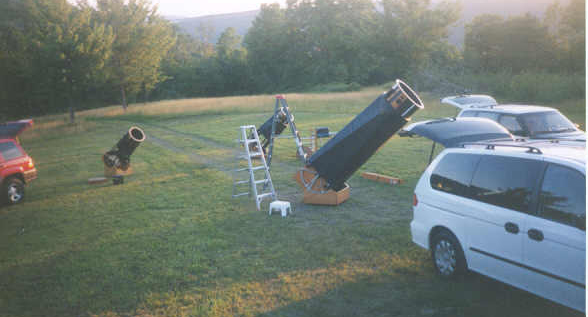
On Saturday November 13th (the rain date), David Segelstein hosted a star party for beginner astronomers at Dorbrook park on Route 537 in Colts Neck. About 20 STAR members were there. There was a forest of scopes of all kinds, ranging in aperture from an 80mm refractor to a 14.5" newtonian, and in style from simple dobsonian mounts to a computer controlled Schmidt-Cassegrain complete with a real-time low-light video system.

Specially made star charts were handed out to new members. Several people learned how to find new objects in the night sky. Everyone learned about dew! As usual for a star party, the skies were moderately cooperative all night, with some haze and clouds, but cleared up beautifully as soon as we packed up and left.

All in all, a night of astronomy at its best. Everyone went home tired and happy. We'd like to do this again soon, perhaps at a darker site.

Your First Telescope

By Mike Lindner

OK, you're a new STAR member, and you're interested in astronomy but don't yet have a telescope. Or perhaps you are not a STAR member, but are reading this newsletter and thought about what to buy for "X". Here's a guide to buying a telescope for someone who doesn't already have one.

First, some terminology. There are basically three kinds of telescopes. A refractor uses a lens at the front of a tube to bend light. This is the scope that pops into most people's mind when you say ``telescope.'' A reflector has a mirror at the back of a tube to bend light. The newtonian reflector, named for Isaac Newton, is probably the most common telescope used for amateur astronomy. A catadioptric scope has a combination of lenses and mirrors to bend light. These stubby-looking scopes are often found in ads in the backs of astronomy magazines. A lot of places are selling telescopes called dobsonian telescopes. These are actually newtonian reflectors on a very sturdy, inexpensive mount based upon the design of John Dobson.

There are a lot of numbers thrown around when talking about telescopes. For a first scope, you can ignore most of them The most important criteria when choosing a scope is aperture. Aperture is the diameter of the opening that lets light in the front of the scope. Bigger is better, for two reasons. The main reason for needing a telescope to see objects in the night sky is that they are too dim to see without a telescope. In non-technical terms, the telescope takes the light that falls on its mirror or lens, and squeezes it so that the light fits through your eye's pupil, much like a funnel catches more rain than a test tube. The second reason why bigger is better has to do with the nature of light itself. Without getting into physics, the larger the aperture of the scope, the more detail can be seen in its image. In general, a scope with less than 3" (about 75mm) of aperture will not show you anything except the moon very well.

So, what scope should you buy? Let's start with a word about what you shouldn't buy. Don't buy a small ``department store'' scope (typically a 60mm refractor). The small aperture, poor quality of the optics and mount can be more discouraging than encouraging to a beginning astronomer. Does all this mean you should go get the biggest scope you can afford? Not necessarily.

Here's a holiday shopping list, ordered by price. You will notice some bias by me. I stopped at under $500, as I wouldn't personally invest more than that on a first scope. Even if you're rich, better to start here and decide which expensive scope you want to wind up with, rather than starting with an expensive scope and wishing it were another expensive scope.

Also, I do not believe a beginner needs a scope with a computer. I personally have more fun learning to find things on my own, and think the money is better spent on more aperture. I am not a big fan of equatorial mounts. Unless you're doing photography or high powered planetary viewing, such a mount isn't needed and again I'd rather put the money into aperture. I also favor reflectors, again, because I can get more aperture for the same dollars. There are no refractors I know of under $500 that equal the image of even a 6" newtonian.

That's not to say that people with expensive computerized refractors on equatorial mounts are evil. Ultimately, you are buying the scope for enjoyment and learning, and so the best scope for you is the one that you use the most, and that's the one makes you happy. In fact, I challenge you, the reader, to write and tell us what your favorite scope is and why.

Without further ado, here's a list of astronomical goodies that make me happy.

Astronomy Club Membership: Perhaps you think this is self-serving, but this is the best value I know of. For about $20, your loved one will get exposure to all sorts of astronomical reading material and equipment, and have a chance to learn astronomy hands on.

Beginning Astronomy Guide: These range in price from $15 to $40, and include Turn Left at Orion, Nightwatch, 365 Starry Nights, and others. There is nothing worse than having a telescope and not having any idea where to look or what to look at. Publications such as Astronomy and Sky & Telescope are good magazines, but often don't cater to the beginner. Skywatch 2000 is a better choice for a first magazine. Online bookstores, such as Amazon (http://www.amazon.com) offer substantial discounts on these books versus buying them locally.

Binoculars: Even an inexpensive pair ($50-$100) can show hundreds of interesting objects, and the same pair is useful during the day for ball games, birding, etc. You may already have a pair. As noted, bigger is better. 40mm is about the minimum size.

Bushnell Voyager 78-2010: This unusual shaped scope is a 4.25" Newtonian reflector. At $180, it's an excellent value, and is very portable (the scope is less than 2 feet long). Along with this scope, I recommend a Rigel Systems QuickFinder ($40). Many places, including Pocono Mountain Optics (http://www.pocmtnop.com/) carry this scope and finder. If you have the room for it, for just a few dollars more, however you can get...

Discovery Telescope FirstLightTM 6" f/8: At $219 this has to be a best buy for the beginner (http://www.discovery-telescopes.com/). Although much less portable than the Bushnell above, the 6" aperture gathers twice as much light as the Voyager 78-2010. With this scope and most other reflectors, I'd recommend a Telrad finder ($40).

Discovery Telescope 90mm Equatorial Refractor: This is the least expensive usable refractor I know of ($349). There are less expensive refractors, such as the Orion ShortTube 80mm Rich-Field Refractor from Orion Telescopes (http://www.telescope.com/default.asp), but by the time you buy a star diagonal, eyepiece and mount, the cost of such a scope is higher.

Discovery Telescope 8" DHQ or Coulter ODYSSEY 8": Another two in the best buy category, at $399. Going from 6" to 8" gives us almost another doubling of light gathering ability. This is a scope a beginner won't outgrow for a long time. Coulter's web site is (http://www.murni.com/coulter.htm).

Constellations for December

By Penny Fischer

A "Rich" Charioteer, and a "Poor" Winged Horse

In this month's tour of the constellations, we meet a Winged Horse, and a Charioteer of Children.

Auriga is one of the brightest constellations in the wintertime sky, rising early in the evening in the Northeast.

Auriga, or the Charioteer, was believed to be the invention of Hephaestus, who is also known as Vulcan in Roman mythology. Hephaestus was crippled early in life and unable to ambulate on his own. He dreamed up the Charioteer so he could be free to come and go as he pleased. Because Hephaestus was a child, Auriga is depicted in the sky carrying several "children" on his arm. These stars eta, zeta and epsilon Aur, are called "The Kids". eta and zeta Aur are both famous eclipsing binaries.

Auriga boasts a 0.1 magnitude star, Capella, the 6th brightest star in the sky. Besides Capella, there are several very bright and well-known open clusters in Auriga, including M36, M37, and M38. Auriga lies in a widening patch of the Winter Milky Way, and because of this, gaseous nebulae abound, including IC 405, the Flaming Star. Because Auriga lies in the galactic plane, the area is considered "star rich".

If your eye travels away from Auriga, towards the zenith at this time of the year, you will be able to make out a large square of four 2nd magnitude stars. This is the famous Great Square of Pegasus.

Pegasus the Winged Horse was created by Poseidon from beach sand, blood and sea foam. The blood came from the head of Medusa, which Perseus had slaughtered with his sword. Perseus then used this newly formed creation as a nifty means of transportation!

This noble horse's wings and legs drift out from the Great Square, with the horse's nose ending in the bright star, Eniph. You can use this star to easily locate M15, a bright globular cluster. It is only about two degrees away from Eniph.

When we are looking out through the Great Square of Pegasus, we are looking outwards towards the edge of the galaxy. The stars inside the square are sparse or "star poor". This is because the distance to the edge of the galaxy, from our apparent view of the Great Square, is only a few thousand light years away! Because we can peer unfettered out towards deep space,

Pegasus has several beautiful galaxies, including the elusive Stephan's Quintet. This diminutive grouping of five galaxies is estimated to be 400 million light years away! By comparison, the Andromeda galaxy is a next-door neighbor, at 2.3 million light years away.


World Wide Web Home Page for S*T*A*R http://www.starastronomy.org

S*T*A*R Telephone Line 732-888-4378