The S*T*A*R

SPECTROGRAM

The newsletter for the Society for Telescopy Astronomy and Radio

November 1999 Copyright © 1999

Contents

Important Announcements News & Events
Notes from October Temple-Tuttle and the Leonid Meteor Shower
Will You See the Great Meteor Shower of '99? Poland Springs...
Constellations for November S*T*A*R Fundraiser

Important Announcements

Our next meeting will be on Wednesday, November 3, at 7:30 PM at the Poricy Park Nature Center. The guest speaker will be Dr. Pryor, who will speak about globular clusters. They are among the densest, oldest and most populace star clusters on our galaxy. Dr Pryor will tell us what we know and what we have to learn still about these massive star structures.

Dr. Pryor's research has produced over forty papers. His main focus has been on globular clusters as well as dwarf galaxies and galactic clusters. His web site can be accessed at http://www.physics.rutgers.edu/~pryor/.

Dues for the '99-2000 year are past due! Dues are $20 and may be mailed in or given to treasurer John Gasparini at the November meeting.
We need articles for the Spectrogram! Would you like to write one? See /Library/Spectrogram/author.html for article submission guidelines, or ask Mike Lindner about it at the next meeting.
One of the club's biggest expenses is printing and mailing this newsletter. If you have internet access and would like to save the club time and money (and save trees at the same time), send e-mail to mikel@att.net; I'll send you e-mail when the new Spectrogram is on-line, and you can read it at /Library/Spectrogram.

News & Events

11-6 Taurid meteor shower.
11-11 LINEAR-id Meteor Shower. This is debris from comet LINEAR. May or may not be a good shower.
11-15 Mercury transits the Sun. Only the beginning of the transit is visible from NJ, as it occurs right at sunset.
11-17 Leonid Meteor shower peaks. This is potentially a very active meteor storm! The Roosevelt Young Astronomers Club in Roosevelt NJ will be holding an Leonid watch at Assunpink Wildlife Management Refuge, weather permitting. Contact Penny for more information.

Notes from October

By Dave Hayden

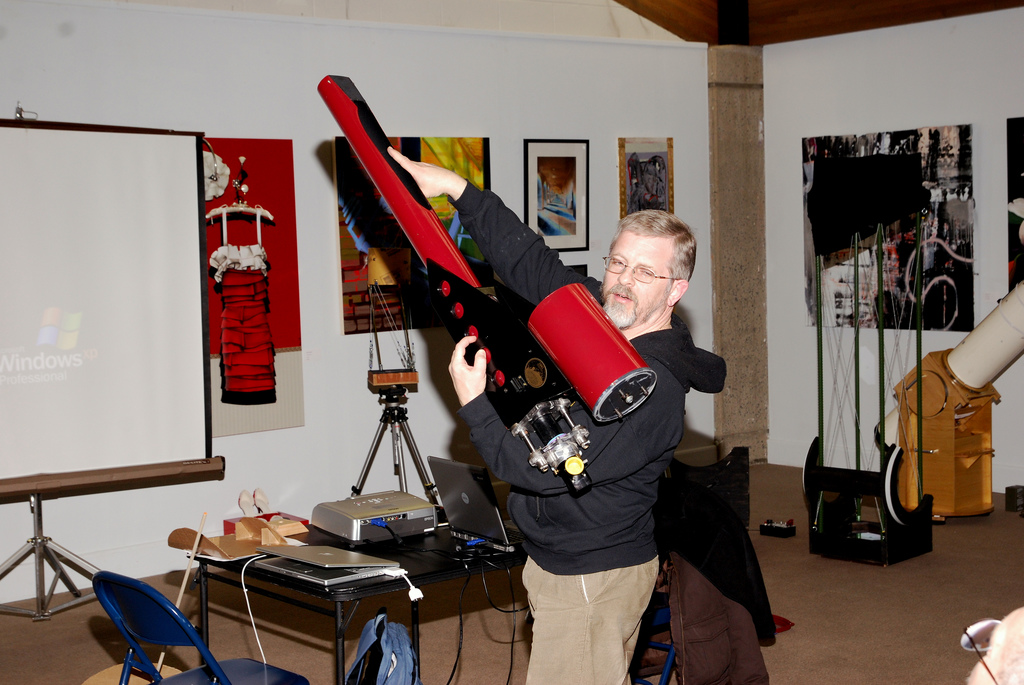
Rob Teeters showed off his "copy scope." A copy scope is a refractor where the objective lens is from a copying machine. Rob says you can get lenses for about $50 and the rest is basically plumbing equipment.

The Connecticut Star Party was a big success. Joe Cascella has Tee shirts, Calendars, and Observing Handbooks for sale. Proceeds benefit S*T*A*R. Please get your orders in by November 6th.

Astra held a public star party outside the Novins planetarium on 10/15. Penny did a public viewing for the Cub Scouts on 10/16.

Dan Pontone is looking for helpers with the Stimulating Saturdays program. There are 12 sessions on Forrestdale School in Rumson with a bunch of 3rd through 6th graders. This brings in $350 for the club. Dan also as found a supplier of nice accessory cases for only $10. The cases don't have foam, but foam is easy to find.

Ed Patoma's scope is at Phasor Video in Red Bank. Dan has taken it out for a little sidewalk astronomy recently. It's a big hit, with By Dan's estimate, over 1000 people looking through it so far.

Penny has an applications for the Winter Star Party in Florida. See her if you want a copy.

Penny was featured in a story about the SETI@Home project in the Asbury Park Press. Also, her article on S*T*A*R will appear in the March issue of Astronomy magazine.

The speaker was Robert Strausberg, a 13 year old meteorite collector. Robert brought is substantial collection and gave a great talk. There are basically 3 types of meteorites, stony, stony iron and iron. Their cost ranges from about $13 to several million dollars. Most weigh a small number of grams. There are some that weigh kilograms. Small meteors are falling to earth all the time and Robert indicated that these can be detected with a home made detector.

In 1992 in Peekskill, NY, a meteorite hit a car. He has a piece of that one weighing a few grams which cost him $70. You can lease the car that was hit! Starting a collection is easy, but you must be very careful of the dealers to make sure you're getting what you pay for.

Temple-Tuttle and the Leonid Meteor Shower

By Penny Fischer

The Leonids are the result of Comet Temple-Tuttle, which has an orbit of 33 years.

Temple Tuttle was first discovered in 1865. It was determined to have a 33-year orbit, and that makes it a short-period comet (as opposed to a long period comet, like Hale-Bopp, which has an orbit around the sun that takes thousands of years.

Although it was not seen during the expected return in 1899, and again in 1932, it was "recovered" in 1965, and returned again in 1998!

Although the comet is famous for bringing us the Leonid meteor shower, it is not especially bright, even at it's closest approach in recorded history, in 1366, it was only about 3rd magnitude. That approach made it one of the closet comets to ever come near earth, about the 3rd closest comet to ever fly by Earth. In the 1998 appearance, Comet Temple Tuttle was not readily visible to the naked eye.

Temple Tuttle last made it's way into the inner solar system last year in 1998. Because of this, some astronomers think that this year there will be a Leonid storm.

Why a storm? Because, when the comet moves through the inner solar system, it drops off a lot of cometary dust and debris into the space it moves through. Each year in November, our planet passes through the dust trail left by that comet. It's the dust that sparkles up and turns into meteors as it enters our atmosphere. The dust heats up and the friction of the atmosphere causes it to vaporize and light up. Although the meteors look very close, they are actually at least a hundred miles up, in the upper atmosphere.

Because the comet had just passed and left a fresh batch of dust, astronomers believe this year we will have a spectacular shower.

The last spectacular shower was 33 years ago, in 1966. For a few- hour period on the night of November 17th, 1966, thousands of meteors fell at a time creating a dazzling display. This kind of meteor shower is actually called a "storm".

Some different meteor lingo:

A meteor is a piece of cometary dust or rock, which enters Earth's atmosphere.

A meteorite is a meteor that survives Earth's atmosphere, and lands intact onto the surface of Earth.

A fireball is a meteor that appears very bright in the sky, sometimes as bright as the full moon, and it even sometimes leaves a smoke trail from the vaporized meteor that is visible for several minutes afterwards.

A bolide is a fireball that is large enough that it breaks the sound barrier, and creates a sonic boom when it enters the atmosphere. Bolides and fireballs can sometimes break into pieces, although almost all meteors are very small bits, either rock-sized or smaller.

Will You See the Great Meteor Shower of '99?

By Rob Teeter

Years from now when people are remembering the Great Meteor Shower of '99, will you be able to tell them you witnessed it first hand? Will you be able to relay to them the significance of this as the most powerful meteor shower since 1833? Will it even be possible to put what you will see into words? This all depends on the outcome of what some professional astronomers are calling the Great Meteor Shower of '99. With it's more traditional name, the Leonid Meteor Shower, it is set to erupt into a fine display of 'shooting stars' covering the sky on the morning of November 18, 1999. With no moon in the sky during the morning hours of that night, the conditions will be prime for spotting as many meteors as the darkness of the sky will allow, on this, the thirty-three year peak of the shower.

While this year's Leonid Meteor Shower could be quite stunning, it will never match the stirring display it put on in the late fall of 1833. During the 19th century, meteor showers were not predicted, nor were they understood as thoroughly as they are today. Due to these circumstances, the meteor shower came virtually unannounced on the night of November 13, 1833, and sent our country into a panic. People were awoke from their sleep to sound of others, those fortunate to have been up at the time of the peak of the shower (nearly 2:00am), shouting and praying to God to save them. The majority of people had thought judgment day had come and that the world was ending. The sky was described as having been on fire and without a single inch not covered with these 'fireballs.' Estimates of the rate of the meteors go as high as 150,000 meteors seen per hour! Here in the late 20th century a high rate for a meteor shower is in the range of 80 to 90 meteors per hour. As you can see, this was quite a spectacular event! Furthermore, once a town went to sleep all outdoor lighting was vanquished and the skies were left pitch-dark for the rest of the night during the shower. Better conditions could not have been had for viewing this major outburst of meteors.

During this year's Leonid Meteor Shower, we will have to make the most of our suburban skies as long as they are clear. Since the moon will not set until roughly 1:00am on November 18, the best viewing of the meteor shower will occur after that time. Any brightening of the sky (natural or otherwise) will greatly diminish the amount of shooting stars seen. Plan to head out that night before 12:30AM since your eyes will require that one half hour before viewing to adjust to the darkness outside. Once that time passes you will be as ready as you can be to have a successful observing session. The best thing about watching a meteor shower is that you do not need any expensive equipment such as telescopes or binoculars, just the most precise optical instruments you own; your two eyes, since you will need as wide a view of the sky as possible. With that in mind, you should also plan on having either a lawn chair or blanket outside with you. Being uncomfortable while viewing a meteor shower will greatly detract from it's wonder. Now that you know when to go out and how to prepare yourself in order to be comfortable for this, you need to know where to look.

While most meteors will streak (and yes, they will streak and streak fast; lasting only a second or two) across small portions of the sky, some are known to go from horizon to horizon. In order to make the best observations, you should plan to set up favoring the Eastern sky. Around 2:00 on the morning of November 18, the constellation of Leo will be up high in the Eastern sky. As you watch the meteor shower, most, if not all, the meteors will appear to originate from within the constellation, hence the name Leonids.

My personal experiences have shown this meteor shower to be the most impressive of the major showers I have observed. While there may not have been hundreds of meteors per hour, some provocative meteors have been seen. Their distinct red and green colors, trails which have lasted up to 30 seconds and some that have started out as plain meteors but then split into two and left two large trails stand out as some of the more interesting Leonids.

If you find yourself with an open schedule for the morning of November 18, 1999, then plan for the Leonid Meteor Shower covering a sky near you starting promptly at 1:00am. Never again this millennium, nor in the very near future, will there be a meteor shower as intense or as perfectly timed so as not to have the moon interfere, as this year's Leonids. Counts may go as high as 120 meteors an hour or as low as 60 meteors an hour, or maybe even higher or even lower. Meteor showers are very hard to predict, but you can be sure if you are not out there and prepared for the best, you will not see anything at all. Good luck and good night!

Poland Springs...

By Dan Pontone

...or ``What I did on my Summer vacation.''

Every year I go on a vacation planned around the new moon, so I can get a week's worth of observing in. This summer I rented a house on the ocean in Marlborough, Maine; a few miles from Bar Harbor.

The sky is jet black. The only light pollution is from Bar Harbor. The telescope's location is a rocky bluff, where the lobster boats pick up their traps. Arriving after an eleven hour drive, my butt hurt from sitting so long. I set up my telescope in anticipation of the coming twilight. I was not disappointed.

The Milky Way stretched from horizon to horizon. M81 and M82 were naked eye! Steam was coming out of the teapot. Seeing and steadiness were quite good. I would rate this night a ``9'' out of 10.

I started observing in Sagittarius, moving up to the Scutum star cloud. The highlights were too many to list! The icing on the cake were Barnard's Dark Nebulae. Most of this is not visible anywhere in NJ.

My heart pounded, and I felt renewed. Planetary Nebulae screamed into my eyepiece. Galaxies looked like pictures. Mosquitoes left me alone. My telescope was performing like a Ferrari at LeMans.

Then all of a sudden, a rustling in the foliage! Was it the Blair Witch coming to visit me? But no, it was just a deer looking for food.

All in all I had four stellar nights, did over 80 objects on the Herschel 400 list. Ar dinner I had lobster each night at $2.75 a pound. Steamers picked out of the Atlantic at low tide. A vacation to remember. Wonder where I'll go next year?

Constellations for November

By Penny Fischer

In this month's sky tour we look towards the Northeastern sky, where the constellations of winter are just under the horizon, and the dimmer fall stars spread outward in faint and brilliant patterns.

Although most of the constellations in this story possess few bright stars, the myth itself is well-known.

Queen Cassiopeia was the beautiful and boastful wife of Cephus, King of Ethiopia. Her boasting infuriated Neptune, god of the sea. To appease Neptune, the King and Queen were ordered to sacrifice their lovely daughter, Princess Andromeda, to a sea Monster, Cetus. They dutifully chained their daughter to a rock by the sea to meet her fate.

To the rescue came Perseus, who had acquired winged sandals and a helmet that let him fly. When he first flew by Andromeda, it was said that he thought her to be just a beautiful marble sculpture chained to a rock. But he saw her hair gently blowing in the sea breeze and the real tears that fell from her eyes. He immediately fell in love with the chained princess. He asked the Queen and King for the princesses' hand in marriage, in exchange for killing the sea monster. The parents readily agreed, and Perseus slew the monster, some say by brandishing the head of Medusa. The two were wed and lived happily together. Cassiopeia is a bright constellation which looks either like a "W" or an "M" in the sky, depending on the season, in the northern sky. The five bright main stars form one of the most recognizable asterisms in the Northern Hemisphere. In mythology, Neptune placed Cassiopeia on her throne in the sky with her head pointed toward Polaris. In this way, she spends half of every night seated upside down.

The loose V shaped Andromeda fans out from the Great Square of Pegasus. The V shape of stars represents her flowing gown, with fainter stars representing her outstretched chained wrists.

Perseus follows his Princess in the sky, with one hand holding a sword and another holding the head of Medusa. The variable star Algol is the eye of Medusa, and it is because of this that Algol is also known as the "Demon Star".


S*T*A*R Fund-raisers

Once again, S*T*A*R is making available several items at discounted prices. All proceeds benefit S*T*A*R. Below is an order form which should be sent along with a check for payment. We will be placing all orders immediately after the November S*T*A*R meeting so that all items can be delivered to members at the December meeting. ORDERS WITH PAYMENTS WILL BE ACCEPTED AT THE OCTOBER & NOVEMBER S*T*A*R MEETINGS. Mailed orders must be received by Saturday November 6, 1999

Checks should be made payable to:


	STAR Astronomy Society

Mailed orders should be sent to:


	Joe Cascella
	34 Bucknell Drive
	Hazlet, NJ 07730

Samples of current and/or past items will be available for examination at the Oct. and Nov. S*T*A*R meetings. All prices noted include shipping and handling.