| October 1999 | Copyright © 1999 |
| Important Announcements | News & Events | |
| Upcoming Star Parties | Notes from September | |
| The ATM SIG | Observers: A Hearty Breed | |
| Constellations for October | S*T*A*R Fundraiser |
![]() |
Our next meeting will be on Wednesday, October 6, at 7:30 PM at the Poricy Park Nature Center. The guest speaker will be Robert Strausberg, who will talk about meteorites. This promises to be a very interesting evening. |
![]() |
John Gasparini at the October meeting.
Dues for the '99-2000 year are past due! Dues are $20 and may be mailed in or given to treasurer John Gasparini at the October meeting. |
![]() |
10/16, 7:30 PM, Englishtown, NJ. Cub Scout Star Party, for the Cub Scouts family weekend, Quail Hill Scout Retreat. SCOPES NEEDED! Please contact Penny Fischer. |
![]() |
S*T*A*R's own Bright Star 100 list is now available on the Web site. Members who complete the 100 objects will get a certificate. Rob Teeter leads the way currently with 42 objects. |
![]() | Want to share a story about an interesting observing session or other experience relating to astronomy? Let Mike Lindner ( mikel@att.net) know, and we'll put it in The Spectrogram. You don't need to be a Hemmingway, thanks to your friendly neighborhood editor. Give it a whirl! |
![]() | Remember to check the club's discussion board on the Internet at /cgi-bin/starbbs.pl , or the club's phone messages at 732-888-4378 to find out about club observing sessions. |
![]() | 10/15, Astra (Astronomy Society of the Toms River Area) Autumn Star Watch (rain date 10/16) at the Robert Novins Planetarium at Ocean Community College. They need scopes |
![]() |
10/9, Blowing Rock, NC. Blue Ridge Parkway Regional Stargaze, by the Catawba Valley Astronomy Club, Julian Price Park, south of Blowing Rock. No registration fee. Public restrooms, but no lights or electricity. Campsites are about a quarter of a mile away; first-come, first-served. For more information send a self-addressed, stamped envelope to Greg Kirby, 5026 Poplar View Lane, Granite Falls, NC 28630, or call 828-396-7656 |
![]() |
10/1-3, Ottsville, PA. Stella Della Valley Star Party , by the Bucks-Mont Astronomical Association. See their web site, at http://www.freeyellow.com/members2/bmaa/index.html for details. Rob teeters says this was really good in 1997. It's about 60 miles away at a private camp with Nice facilities. |
![]() |
10/8-10, Woodbine, NJ. South Jersey Star Party , by the South Jersey Astronomy Club, Belleplain State Forest. Contact Paul Ostwald at paostwald@aol.com , or visit the club's web site at http://members.aol.com/sjastroc/ . |
By Dave Hayden
The 50/50 raffle prizes were laminated Messier and Caldwell catalog cards. Penny passed around a letter she received from Congressman Rush Holt regarding NASA funding cuts.
SCOPE & TELL: Mike Lindner showed his 13" Coulter Dobsonian. He got it on the internet for $300 and made several modifications. The scope weighed about 110 lbs, so he cut some large holes in the mount and replaced the base with some light weight feet. He couldn't collimate it at Jersey Starquest, so he replaced the mirror cell with a nice one he built from scratch. Then he added a new focuser. The secondary mirror holder was a pain to adjust, so he replaced that with a commercial one. He got a dew cover from Dan. The dew cover threw the balance off, so he added some 5lb counter weights. Finally, he added a heater. Even with all the additions, the scope now weighs about 85 lbs.
Mike runs the Amateur Telescope Making Special Interest Group (ATM SIG) in the club, and obviously has some experience! Talk to him if you're interested telescope making. You can reach him via email at mikel@att.net.
Dave Hayden then showed a video tape of the STS-93 Space Shuttle landing. This was a night time landing and the view was from the heads up display in the shuttle cockpit. The full tape shows the landing from about an hour before touchdown. Contact Dave at dave@xpedite.com if you would like the borrow the tape.
Joe Cascella would like to do some public programs for kids and novices and he's looking for ideas. The S*T*A*R phone line is 888-4378. Joe is looking for some assistance in helping to answer questions that come into the phone line.
Fund Raising. We'll be selling S*T*A*R hats & tee shirts, as well as observing books and wall calendars again this year.
David Segelstein then showed the new telescope donated to the club by Ed Potoma. Ed and his father cleaned corrosion off the scope and generally cleaned it up. Unfortunately, as they were taking it apart, it fell over, damaging the tube and the R. A. motor. Don Odegard fixed the tube (nice job, Don!) and Don & Dan Pontone fixed the motor. The scope was built in 1961. It's a 10" newtonian on an equatorial mount with a motorized RA drive. It was huge for its day. The axes use 2" shafts. The RA axis has a hand controller as well as a motorized drive. It even has a little flashlight built into the mount. The tube rotates using an interesting design. The plan is to display the scope at Poricy and wheel it out for use occasionally. David also wants to attach some equipment so people can use it for photography. That way people can get their feet wet with photography without spending lots of money. David thanked Dan Pontone for getting the scope. Dan thanked Ralph Marantino and "Barlow Bob" Godfrey for leading him to the scope. He also thanked the AAAP for leading us to the scope.
[Since the meeting, Poricy has refused to let us display the scope at the Nature Center. Instead Dan Pontone arranged for it to be displayed at Phasor Video and Electronics at 70 White St. in Red Bank. The owner has given it a prominent place, along with brochures for the club, and may even help us with drive electronics for guiding the scope. Dan said that the other night he stopped by, took the scop eout on the sidewalk, and showed the moon and Jupiter to about 150 people! Stop by and maybe do a little sidewalk astronomy yourself! -- Ed.}
John Gasparini spoke about club dues, which are now $20 for an individual and $30 for a family. Dues are due now and cover September 99 through August 2000. With your membership, you can get discounted subscriptions to Astronomy ($29/yr) and Sky & Telescope ($29.95/yr) magazines. To get the discount, you pay the club and the club pays the magazines. Contact John at gasparini@att.net for details.
John Batinsey spoke about developments in light pollution. GPU has made a full cutoff shielded copper head a stock purchase item. With this new development, John recommends that members not send the letter he passed out last year when he spoke. He has a new letter which he passed out. John asked members to send the letter to GPU and their local Municipal Environmental Commission.
We now have permission to observe at the Greenwood Forest Wildlife Preserve, off of exit 80 on the Parkway. See Penny for directions and the authorization letter.
David Segelstein said that if you have a telescope or would like to know about telescopes, feel free to talk to him, Dan Pontone, Dan Odegard, or Mike Lindner. The 4 of them are walking encyclopedias on all things telescopic.
Jay Respler then showed his video of the recent eclipse. Jay took a cruise off the South West coast of England to catch the eclipse. The weather was bad, but luckily the only 5 minutes that day when you could see the sun were the 5 minutes around totality. Jay's video was stunning, even with the clouds. The next total solar eclipse is in 2 years and covers Southern Africa and Madagascar. Start making those safari reservations!
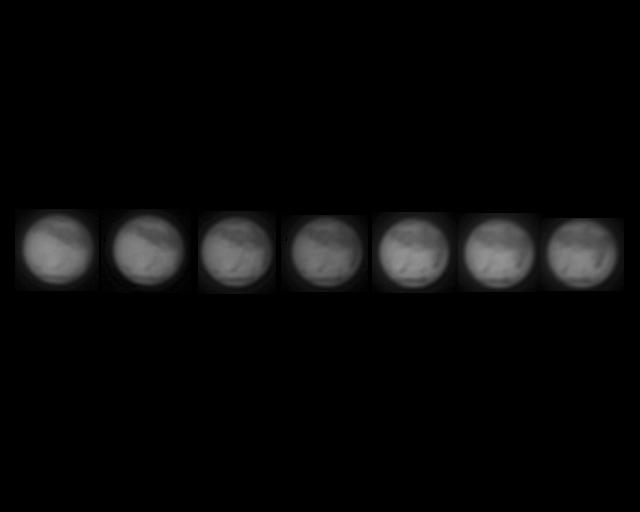
Our speaker was planetary scientist Allen Witzgall who spoke on spacecraft visits to Mars. Spacecraft exploration of Mars began in the 1970s with Mariner 7 and 9, and later Vikings 1 and 2. There was a long hiatus in the 1980s. In 1990, the Mars Observer fell silent, probably because of a failed timing transistor. It's probably sitting in Mars orbit right now waiting for an internal signal that will never come. More recently, the Mars Pathfinder mission landed and returned great photos and valuable data. The Mars Climate Surveyor and Mars Polar Lander and on the way.
Allen showed a variety of images of the Martial polar caps, huge valleys, volcanos, impact basins, and even 3D views of the Pathfinder landing site. He finished by asking members to contact their Senators to oppose recent cuts to NASA's budget that threaten several planetary missions. For further reading, Allen recommends the books ``The Case for Mars'' and ``Destination Mars.''
|
A bit of background on this month's comic. It comes from the comic strip ``After Y2Ktm'' by Nitrozac (http://www.After-Y2K.com). The strip takes place, as the name suggests, after the ``Y2K'' bug has shut down power grids, ATMs, etc. You get the point. Enjoy! |
|
By Michael Lindner
This past spring, a group of S*T*A*R members forms a SIG, or Special Interest Group, devoted to ATM, or Amateur Telescope Making. Telescope making has always been a part of the club's activities. Several club members, including the author, have built their own scopes. Check out the club's telescope making section at /TelescopeMaking/index.html or the member equipment pages at /Members/Equipment/index.html to see some examples of fine scopes built or rebuilt by club members.
For those who have never considered it, let me assure you that it is simple to build a telescope. The only required skill is patience. The benefits include learning how a scope works and how to fix and maintain one. Of course, the SIG is about more than just building telescopes. We began by building observing chairs, and have made things like red flashlights, finders, eyepiece holders, and dew heaters.
The SIG is open to all interested S*T*A*R members. There is no fee to join. We meet irregularly to work on any project of interest. Currently we have a number of projects going. We are assembling Ed Collett's TeleKit and refurbishing the abused club loaner scope. Several members, such as Balaji Ramani and Rob Teeter, are building scopes.
If you are interested in any project having to do with astronomical equipment, or just want to find out what it's all about, see Mike Lindner or David Segelstein at any S*T*A*R meeting, or drop Mike a line at mikel@att.net.
By Joe Cascella
When you think of a ``tough'' hobby, one might think of weight lifting, rock climbing, or some other kind of athletic endeavor. When the words ``tough'' and ``hobby'' are put together, we are usually thinking about something that is physically demanding. But what about a hobby that taxes one's mental state? For many hobbies, mental and emotional preparedness is just as important as the physical readiness. The physical side may actually be secondary. I submit that amateur astronomy, particularly its observational side, is as demanding as any other hobby or activity out there for this very reason.
Let's look at the amateur astronomer who tries to get in his/her share of observing the night sky. By their very nature, observers are working in the dark, in as remote an area as they can find. Mental toughness is required or fear will get the better of them. There are scores of motion pictures documenting the risks of being in such circumstances, the most recent being the ``Blair Witch Project.'' Observers have no such fear! A shot at that minuscule dim object is far more important than risk to life and limb caused by the Jersey Devil, or wild tigers running loose in the area, or some other form of evil spirit. Observers will also travel at great lengths to get to even darker and more remote sites. A two hour drive, even with the risk of being clouded out (a far greater fear than evil spirits, wild tigers, Blair Witches, etc.) is nothing to this staunch breed of human. And while most people like the warm, breezy evenings of summer, observers look forward to clear, cold, raw evenings of winter. You have to be mentally tough to know you'll be out in the freezing cold, for hours at a time, and still do it in the name of enjoyment.
There are huge emotional strains on observers. That doesn't slow them down. For several weeks during the month, the night sky could be cloud free. It's a known fact that it's always crystal clear on the nights around the Full Moon. But when the New Moon approaches, and observers gear up for that perfect Saturday all-nighter under the stars, Mother Nature slaps them with an overcast weekend. In fact, it's also a known fact that the more amateur astronomers there are wanting to observe, the greater the potential cloud cover for the evening. Has something to do with a combination of cosmic inversions, El Nino, and the ocean tides, or something like that. Saw it on a report on the Weather Channel. There's also a lot of basis to the theory that the further an observer drives to get to an observing site, the more inaccurate the weather reports of clear skies will be once they get there. This is known as the Pontone Principle. Then there are observers who decide to throw caution to the wind, who will go even further, and drive many more hours in search of that evening under dark skies. That cosmic inversion stuff, and the theories connecting distant traveled with cloud cover really kick in for these hearty souls. But they keep pressing on. Instead of downing a handful of Prozac, observers just shake it off, and look forward to next month.
This cycle goes on month after month. Others would break down from the emotional and mental strain. Not amateur astronomers. They just find outlets to vent their frustrations. Most will thumb through equipment catalogs and start picking up extras for their telescope. That new ultra-something eyepiece, or new finders. Maybe that extra carrying case for all the stuff they bought last year they don't use anymore. Some will even pick up electric warmers for their scopes and optics. That's right, electric warmers for their equipment. Other hobbyists would pick up electric socks or hand warmers, or underwear (no comments please, this is a G-rated publication) to keep themselves warm while out in the cold. But observers are so hearty they can take the cold better than glass and metal!! Then the newest catalogue shows up and sports that new super-deluxe, mega-monster eighteen thousand inch telescope that can see right through lead. Well, who could resist?! The observer doesn't even fear the warning label on the Mega-Monster. It states, `` WARNING: this scope is known to eat puny telescopes and small children. Do not use this scope if you suffer from heart disease, back problems, or cannot lift seven times your own body weight!!''
All the money spent on equipment, and all the time spent away from home in the evenings would put an emotional strain on most couples. But not observers. They have the mental discipline to ignore the pleas of their significant others so they can continue their activities. Can't say that about other hobbyists. Well, come to think of it, you probably can. OK, this one's a draw. Everyone is equally mentally capable of blocking out their significant others in the name of their own interests.
Of course, then there are specialists within amateur astronomers. Among them are astrophotographers, meteor observers, and those nearest and dearest to my heart. I am, of course, referring to that special breed commonly known as Eclipse Chasers. These specialists may be among the most mentally and emotionally tough people in the world. Let's first look at the astrophotographers.
During years of honing one's skills to get ready for a special event, the astrophotographer has spent a huge number of hours, and piles of money, to obtain a few photographs worthy of showing off to their buddies. They are still mentally stable after all the washed out nights (see Cosmic Inversion above) and tons of wasted film. Then, a beautiful comet appears. A chance of a lifetime. The nights best suited for viewing and photographing the comet are, of course, clouded out. (There is another phenomenon pertaining to the rarity and importance of an astronomical object. The more rare the opportunity, the thicker the cloud cover. This is known in professional astronomy circles as the Big Bust Theory). But this doesn't phase the astrophotographer. Instead, the car stays packed with equipment waiting for that one clear night to shoot what will most surely be the crown jewel in the astrophotographer's portfolio. Then the night comes. All conditions are right. Everything goes great. Perfect seeing, equipment works fine. Now to get the photos processed. (WARNING: if you suffer from heart disease, back problems, or cannot lift seven times your own body weight, please consult an astrophotographer before reading on.) In all the excitement over the event, the astrophotographer forgot to load the film into the camera. AUGH! Most hobbyists would simply explode. Not just in an outburst of tears. I mean actually explode, like spontaneous human combustion. But the astrophotographers' mental and emotional toughness has prepared them for such an inevitability. Right now, every astrophotographer reading this is laughing their butts off saying been there, did that!! Not to fret. There's always tomorrow night. Or next month. Or next year, etc. The astrophotographer can tough it out.
As for meteor observers, combine the cosmic inversion AND Big Bust Theory. Enough said. Mental and emotional toughness is a requirement, or else, poooooofffff!
Then there's the Eclipse Chaser. Perhaps the toughest and hardiest breed of amateur astronomer. The Eclipse Chaser combines the Cosmic Inversion, Pontone Principle, and Big Bust theories, then adds an element of extreme financial expense. On top of that, extensive traveling to obscure parts of the world, under weather prospects that are at best marginal, makes for what most people would call a foolhardy endeavor. All in the name of experiencing something that lasts only a few minutes. The rewards of a successful eclipse trip are astounding. But the heartbreak for failure, unbearable. The emotional roller coaster is more than any mere mortal can stand. Yet the Eclipse Chaser will brush aside all the negatives and forge ahead, despite possible overwhelming odds against him. And even if clouded out, will shake off the devastation and immediately begin plans for the next attempt. What courage!
Finally, let's look at the physical prowess of the observer, including all specialists noted. These folks are not only mentally tough, but they are also physically intimidating. The trusses worn by Mega-Monster owners bears this out. Observers are known to touch icy cold metal, in the dead of winter, having their finger prints torn off after getting stuck to the metal. But that's nothing. If you ever want to see how intimidating an observer can truly be, try this. Wait till after all the cosmic inversions, Pontone Principles, Big Busts, dollars spent, miles traveled, months waited, film destroyed, hernias repaired, etc., just to get to the only clear night of the next millennium. Gather as many observers as you can and host the biggest and best star party of the century. Go to the star party and do one thing. Turn on your car's headlights!
DISCLAIMER: The opinions expressed are those of the author and not necessarily those of the S *T* A*R Astronomy Society. Actually, the author doesn't believe most of this either, but it does make for curious reading. Armchair astronomy is excluded in this discussion as the author does not see that aspect of the hobby as being hearty. Any Characters noted are purely fictitious. Any resemblance to real persons, both named or otherwise, is mere coincidence. That is, unless that person is a hearty observer, in which case they should be able to take it and deal with it anyway!
By Michael Lindner
Last month we discussed Capricornus, the sea going goat. This month we skip Aquarius and go straight to Cetus, the whale. Please refer to the charts on the following pages.
Cetus wasn't always seen as a whale, however. The Arabs had three separate groups of stars in place of Cetus; ``the Hand'', ``Hen Ostriches'', and ``the Necklace''. The Greeks saw it as a sea monster, sent by Poseidon to devour Andromeda.
Later, in medieval times, it was depicted as Belua the beast in the Almagest and as the ``sea dog''. Today the stars in Cetus most resemble an easy chair.
There are several interesting objects in Cetus. In between the stars g and z Ceti lies o (omicron) Ceti, also known as Stella Mira , Mira the wonderful, or Collum Ceti. It was accidentally discovered in 1596 by David Fabricius, who noticed its absence. The star was seen in 1603, when it was designated as omicron.
In 1638-39, Phocylides Holwarda recorded its cyclic brightness changes, and in 1667, Bouillaud determined its period was 333 days. This was the first record of a variable star! Mira's luminosity varies by 5 magnitudes over the course of this cycle.
In 1918 A. H. Joy discovered a 10th magnitude companion of Mira. It too, is a variable, dimming by two magnitudes during its 14 year cycle.
Also in Cetus is a small galaxy cluster, including M77. In 1913, Slipher discovered that M77 had an unusually high red shift, which later lead to the theory of an expanding universe.
This month both Jupiter and Saturn are just above Cetus, in Aries. Jupiter is near opposition and perihelion, making this the best time to view Jupiter for years to come
Once again, S*T*A*R is making available several items at discounted prices. All proceeds benefit S*T*A*R. Below is an order form which should be sent along with a check for payment. We will be placing all orders immediately after the November S*T*A*R meeting so that all items can be delivered to members at the December meeting. ORDERS WITH PAYMENTS WILL BE ACCEPTED AT THE OCTOBER & NOVEMBER S*T*A*R MEETINGS. Mailed orders must be received by Saturday November 6, 1999
Checks should be made payable to:
STAR Astronomy Society
Mailed orders should be sent to:
Joe Cascella 34 Bucknell Drive Hazlet, NJ 07730
Samples of current and/or past items will be available for examination at the Oct. and Nov. S*T*A*R meetings. All prices noted include shipping and handling.
![]() |
Observer's Handbook 2000 This annual handbook is published by the Royal Astronomical Society of Canada and has become a standard for many professional and amateur astronomers. The handbook contains detailed information on astronomical events throughout the year including: exact timings for sunrise & set, moonrise & set; eclipses, meteor showers, occultations, planets and their satellites, etc. The handbook also includes basic data and information on many other topics that is useful well beyond 2000. Retail Price: $20.95 S*T*A*R Price: $15.00 * * Discount applies only if sufficient quantity ordered |
![]() |
The Year in Space 2000 Desk Calendar Published by Starry Messenger Press, this desktop calendar includes daily astronomical events and moon phases, daily historical information on astronomy and space flight, and a weekly color photo. Many of the photos are stunning and unique pictures from NASA and the Hubble Space Telescope. This calendar is a great holiday gift for the kids' teachers as a unique and useful gift! Retail Price: $14.95 S*T*A*R Price: $13.00 |
![]() |
Astronomy 2000 Wall Calendar Produced by the publisher of Astronomy Magazine, this 13.5 x 10.5 wall calendar features information on viewing numerous celestial events and has seasonal star charts. Its 12 color photographs and artwork include an image of a Total Lunar Eclipse, a pair of galaxies colliding, and a Hubble Space Telescope image of Saturn. Another excellent teachers' gift for the holidays! Retail Price: $12.95 S*T*A*R Price: $10.00 |
![]() |
S*T*A*R logo T-Shirts White T-shirt with blue and yellow S*T*A*R logo on front. (Adult sizes S,M,L,XL) S*T*A*R Price: $14.00 |
![]() |
S*T*A*R logo Hats White baseball cap style hat, with blue visor and blue and yellow S*T*A*R logo. S*T*A*R Price: $10.00 |
| Name ________________________________ | ___ | Observer's Handbook . @ $15.00 _____________ |
| Address ______________________________ | ___ | Desk Calendars . . . . . .@ $13.00 _____________ |
| ______________________________ | ___ | Wall Calendars . . . . . . @ $10.00 _____________ |
| Phone _______________________________ | ___ | T-Shirts . . . . . . . . . . . . @ $14.00 _____________ |
| size S___M___L___XL___ | ||
| ___ | Hats . . . . . . . . . . . . . . . @ $10.00 _____________ | |
| TOTAL ITEMS ___ | TOTAL $$ ENCLOSED _____________ |
World Wide Web Home Page for S*T*A*R http://www.starastronomy.org
S*T*A*R Telephone Line 732-888-4378