The STAR Spectrogram
The Newsletter for the Society for Telescopy, Astronomy and Radio
April, 2000
Important announcements
Our next meeting will be on Thursday, April 6th, at 8:00 PM at the Colts Neck Fire Company #2 on Conover Rd. in Colts Neck. Our speaker will be Derrick Yoost, from North Jersey, is going to do a talk on meteorites. He has a very extensive private collection which he has gathered from all over the world. He's very very knowledgeable and he should give an interesting talk and display.
We need articles for the Spectrogram! Would you like to write one? See http://www.starastronomy.org/Library/Spectrogram/author.html for article submission guidelines, or ask Mike Lindner about it at the next meeting.
News & Events
Delmarva Star Party near Anapolis, MD is Thursday-Sunday April 6-9. The Delmarva Stargazers presents their sixth annual Delmarva Star Gaze at Tuckahoe State Park in Queen Anne. Call Lyle Jones at 302-736-9842 or visit http://www.delmarvastargazers.org for additional information.
April 16th, New York. The ninth annual Northeast Astronomy Forum and Telescope Show, sponsored by the Rockland Astronomy Club and Sky & Telescope, will be held at Rockland Community College in Suffern. The forum has lots of vendors and lectures, and Al Nagler sells eyepieces for about half off. Get there early. It's about 1hr 20min from Red Bank. For more information contact Don Urban at 73 Haring St. Closter, NJ 07624-1709; 201-768-3295, or send e-mail to donurban@rocklandastronomy.com URL: http://www.rocklandsstronomy.com. .
Finally, Jersey Star Quest is June 2-4.
Notes from March
The Messier Marathon was scheduled for March 11, but all we saw as M0 - the Great Cloud Nebula. Next chance will be March 31 April 1 at Coyle field. The Messier Marathon is an attempt to see all 110 Messier objects in a single night. It can only be done around March each year when the Sun is fairly far from all Messiers. A marathon is a great way to get experience observing. There will also be members present who won't be doing the marathon, so there will be plenty of scopes to look through and plenty of things to see. The key to a successful marathon is preparation. Mike Lindner recommends "The Year Round Messier Marathon Field Guide" by H. C. Pennington. 20 bucks from Willman-Bell.
In other news, the Hayden Planetarium has reopened. Also, Italian scientists think they have discovered WIMPs (weakly interactive massive particles), a type of particle theorized but not yet observed.
Fred Block has setup ICQ and chat services. See the web site for details. Dan Pontone complained about the current discussion board and asked if we could return to the previous software. Mike Lindner and Fred Block recommended against it due to problems with the old software and are looking into alternatives.
Larry Campbell ran a Star Party for the Indian Hill Middle School 3rd graders. There were 4 scopes and about 300 students. He read some of the thank you notes he received.
Andy Zangle showed off the 8" Dobsonian that he bought from Greg Cantrell and rebuilt. Andy didn't want to take the scope out of service during the rebuild. The new mount allows the tube to slide back and forth and is very steady. He used Mike's telrad dew heaters (4 resistors wired in series).
Board Elections are in June. The current Board decided that the nominating committee should consist of a current Board member, a past Board member, and someone voted by the membership. They selected David Segelstein and Dan Pontone as current and past Board members. We voted for Fred Block as the other member. If you are interested in serving on the Board or the programming committee, or if you'd like to nominate someone else, contact David, Dan, or Fred.
Springtime is in the Air. Flowers bloom, eggs hatch, and astronomers get new telescopes. David Segelstein is expecting an 18" Obsession in May. Fred Block is expecting a 20" Obsession August 20, and a baby in September. Enjoy those 3 weeks of observing, Fred!
The evening's speaker was our own David Segelstein who spoke on astrophotography. You can see David, his telescope and some of his pictures at http://www.home.att.net/~dsegelstein .
David's setup includes a huge equatorial mount with fine altitude and azimuth adjustments for polar alignment (he recommends getting a good mount if you want to do astrophotography). He has a low profile helical focuser, an off-axis guider, a Nikon F4, a 41 Amp-hr battery, and a 10" newtonian scope.
David uses the knife edge method of focusing and aligns the scope with drift alignment. His slides clearly and concisely show how both of these methods work.
He then showed a time-lapse video of him setting up his equipment. It took 2 hours to get everything set up and ready to take a photograph. Then clouds rolled in and it was time to take it all down.
In addition to his many outstanding photos, David showed some of his mistakes. Problems included bad focus, forgetting to set the camera on "bulb" so the shutter would stay open, mirror flop in the his old 5" SCT guide scope (this is where the primary suddenly shifts positions slightly), the developing house removing "that red cast" (the nebula he was trying to photograph) from his picture of the stars, a couple where he still doesn't know what happened, the take-up real not catching the film, batteries dying, wind shaking the setup, and photographing the wrong object.
David gets his photos developed onto Kodak Picture CDs. He then processes the digitized images using PictureWindow.
Teeter's (Newest) Telescope
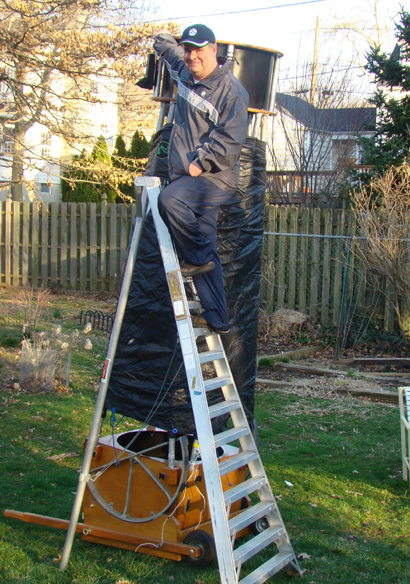
To do something in one's life that leaves a deep lasting impression is one thing, but to take on that task again and do it better is yet another challenge all together. In the short stretch of four years I saw myself purchase my first real telescope and completely reinvent it while winning numerous prizes for it's craftsmanship along the way. Having donated vast amounts of time and effort to it's completion, I am now ready to see to the finish of an even larger and completely different breed of telescope.
The seeds were planted in my mind for this 12.5" Truss-Dobsonian project in the summer of 1997. A friend and observing-buddy brought to my attention a donated 12" mirror blank and solid aluminum truss sitting in his garage. Not being a handyman at heart, he felt I would have more of a use for the set up and was glad to pass it on. Much to my dismay, after measuring the focal length on the uncoated mirror, it was seen to be an unnecessarily short f/2 (24" focal length).
My father and I called around to various mirror manufacturing establishments to inquire about the regrinding of such a short focal length mirror to a more reasonable focal ratio. The common answer was that it was going to be too much trouble to do such a task and that we should just purchase a finished mirror.
The saga of finding a 12.5" mirror that encompassed the ever so important qualities of being reasonably priced and made to be topflight was now unleashed. We started out by scouring the Internet and by calling around and the unanimous conclusion was that this was not going to be cheap. The project was then set back for financial reasons, as most projects are.
However, after doing a year's worth of research and observing, I got on the Internet and found the phone number for perhaps the least known of America's great mirror-makers, Steve Swayze. He not only had a mirror of similar dimensions, but it was sitting on his shelf ready to be shipped. No words could quite portray my extreme glee that I would finally have my 12.5" mirror and would not have to wait an excruciatingly long time.
My 12.5" f/5.5 full-thickness Pyrex Steve Swayze mirror arrived shortly after Christmas this year and was promptly installed into my makeshift optical tube assembly. Initial views through the telescope met and exceeded my wildest expectations, especially when observing the planets and their intricate detail. Contrast in star color was also drop-dead amazing and the amount of magnification the scope could hold was above and beyond what was necessary.
However, the scope saw little use after the first couple nights early this year. In fact, my 8" Dobsonian saw more use, which was a real shame. Weight was the major contributing factor to the big scope's lack of use. The optical tube assembly and base (not built by myself, but purchased from the original telescope-maker) weighs in at about 250 lbs with all wooden parts being made of two pieces of 3/4" plywood and the tube being 5/8" thick by 68" long by 15" diameter. This was your quintessentially over-built telescope and something had to be done and in turn I drew up plans for a Truss-Dobsonian version of the telescope.
As is my nature, I will not settle for the same bland, cut and dry design principals. At the time of the writing of this article, the actual truss version is about halfway constructed while the rest still resides on paper, but most if not all of the innovations pertain to craftsmanship and how the telescope looks compared to how it works.
The first of the innovations is a five-pointed star for the ground board. This was chosen not only for appearance, but also to give the scope a wider foot-print and increased stability, with five feet on the ground compared to the normal three or four.
Another new design factor is the use of a completely aluminum upper-cage assembly to hold the secondary mirror and focuser in place. I like the rigidity of this piece compared to using solid plywood. However, the main reason this was chosen was due to it's ease of assembly since this was part of the original truss assembly given to me back in the summer of 1997.
The poles that will be used for connecting the mirror box to the upper cage are going to be 3/4" EMT electrical conduit, which was the request of my father. Like me, he did not want to do things the time-tested way, but rather experiment. While the EMT is heavier, which is negligible, than the usual aluminum tubing, it is very rigid at the length we require.
As for the attachment of the truss poles to the telescope itself, there are as many different ideas out there as stars in the sky. We can go with any of an innumerable amount of ideas, but rather I prefer my own way which is rather straight forward. To connect the trusses to the mirror box, they will be slid into pipe-clamps attached to the inside of the mirror box. In essence it's the same idea behind Obsession's wood clamp-blocks, but instead made of aluminum and only a fraction of the weight. Under each pipe-clamp will be a wooden stop to keep the truss poles from going too far into the mirror box and to keep them all level at the top of the telescope. In a nut-shell, the poles will be slid into the clamps which are then tightened around the poles by means of a wing nut; something like the idea behind tube-rings for equatorially mounted scopes.
Attaching the truss poles to the upper-cage is a bit more complicated and I will therefore not go too in depth. Each set of two poles (one set for each side of the telescope, so a total of eight poles) will be fastened together on a piece of angle-iron with a hole drilled into the angle-iron between the poles. This hole will then slide over a bolt protruding from another piece of angle-iron fastened to the upper-cage and a threaded knob will be screwed down as tight as possible onto the angle attached to the truss-poles. Obviously, this will not be as quick as if I used clamps, but I feel this is a little more stable.
The internal workings of the telescope, minus the mirrors, have been salvaged from the original optical tube assembly I have been using. The telescope-maker I purchased it from put a lot of time and effort into the construction of a 9-point flotation cell and adjustable aluminum spider/secondary holder. Rather than make my own, I am recycling those older parts and giving them new life in my Truss-Dobsonian.
The last major issue of the telescope is the paint scheme. I fell in love with a black and yellow combination after having that on my 8" Dobsonian and I see that as my trademark. Therefore, all the parts of this 12.5" scope will be either black or yellow. Starting from the bottom up, the five-pointed star ground board will be Safety Yellow, the rockerbox will be black, the mirror box and bearings will be black, the truss poles will have black insulation around them, the aluminum upper cage will be black while the sonotube lining the inside will be Safety yellow. For our 19" side-bearings we used a crescent moon cut-out for handles, and while the bearings themselves are black the cut-out is Safety Yellow. Hopefully this scheme will go according to plan and while looking at the scope at night you will only see the star ground board, the moon on the bearings and the sonotube up top. Hopefully a very neat effect!
Smaller additions to the telescope include the mounting of two muffin-fans behind the primary mirror to help cool it down a technique of using springs (one on each bearing) to keep the telescope from being nose-heavy. However, most of this is still on paper, but will hopefully make it into wood and eventually onto the telescope itself. Finally, as always, I would like to thank those who have helped greatly on this project thus far; my late father, John Teeter, who gave me the confidence to take on such a project, my brother-in-law Jerry Sneed who has taken the place of my father when it comes to cutting wood and contributing ideas, Mike Lindner for his expertise on telescope making and of course my great astronomy friends Don Odegard, David Segelstein and Dan Pontone. Thanks!
Astronomers Needed
HELP TO BRING THE JOY OF DOING SCIENCE AND ASTRONOMY
TO A SCHOOL OR COMMUNITY ORGANIZATION NEAR YOU!
Project ASTRO NOVA is looking for professional and amateur astronomers who live or work in Northern and Central New Jersey and who are interested in visiting a local school or community organization.
Each school year Project ASTRO NOVA pairs third to ninth grade teachers and youth leaders with volunteer astronomers. In the current school year we have 41 astronomers who are partnered with 66 enthusiastic and committed teachers. Some astronomers are paired with two teachers at the same school.
The teacher-astronomer partnerships are established at a two-day workshop preceding the school year, during which the partners meet each other and are and are engaged in effective classroom tested hands-on astronomy activities that meet the State's Science Content Standards. During the workshop partners develop a strategy for working together, in and out of the classroom, and start planning their astronomy lessons and the first astronomer's visit. We have scheduled workshops on August 22-23 (Tuesday and Wednesday) and August 25-26 (Friday and Saturday) at Raritan Valley Community College. Participating astronomers will be assigned to one of these two workshops.
Class visits usually start in the fall and continue through the school year. Astronomers commit to make at least four visits to the same one or two classrooms. During these visits they answer students questions and lead or assist the teacher with astronomy activities. Examples of activities include: Making a Telescope, Stargazing, Exploring the Constellations, the Reason for Seasons, Modeling the Phases of the Moon, Making a Scale Model of our Solar System, Observing the Moons of Jupiter, Making a Comet, Life Cycles of Stars and the Origin of the Universe. Many of our astronomers are finding participating in Project ASTRO NOVA so rewarding and enjoyable that they make several additional visits.
Astronomers who are interested in participating in Project ASTRO NOVA should request and fill out an Astronomer Volunteer Form. On this form, astronomers will be asked for areas of astronomy that are of special interest to them and which grades/ages they prefer to work with. Based on the answers, astronomers will be matched with compatible teachers or youth leaders near their home or work. Each partnership will receive a wide variety of materials and resources for use in their visits, including: The Astronomical Society of the Pacific's The Universe at Your Fingertips activity and resource notebook, articles about recent astronomical developments, resource lists, access to audio-visual materials, tips on working with schools/groups and students, tips on addressing and working with preconceptions and learning styles, and more.
Astronomer Volunteer forms and more information can be obtained from our website at http://www.raritanval.edu/planetarium/astronova.html or from Project ASTRO NOVA, Raritan Valley Community College, P.O. Box 3300, Somerville, NJ 08876, (908) 231-8805, fax (908) 526-7938, or email astro@raritanval.edu.
The deadline for submission of Astronomer Volunteer Forms is April 15.
World Wide Web Home Page for STAR http://www.starastronomy.org
STAR Telephone Line 732-888-4378